
Artificial Intelligence Needs Awareness
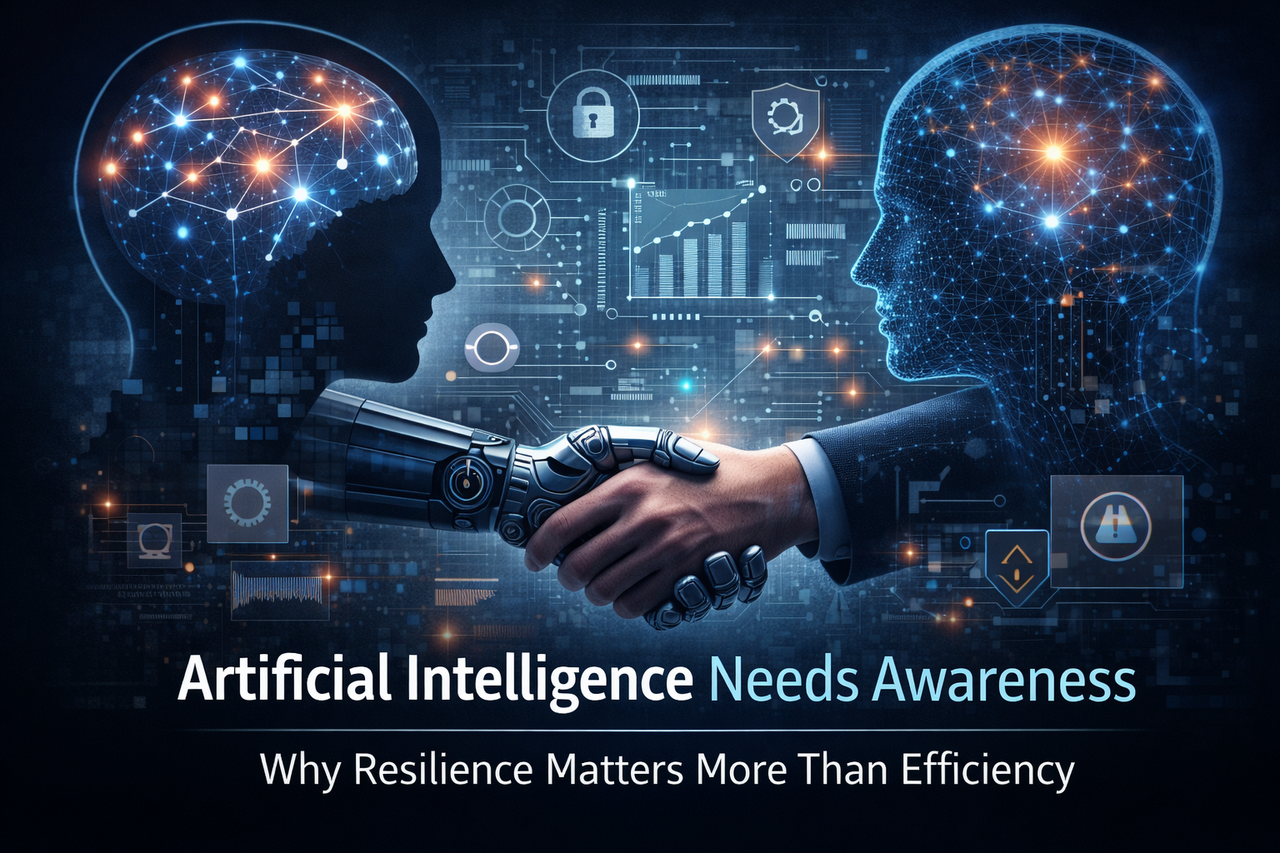
Context
Artificial intelligence is becoming a foundational technology.
Not as a single tool, but as an infrastructural layer that shapes decisions, processes, and perception.
In many organizations, the focus is placed on efficiency gains, automation, scalability, and competitive advantage.
What is often missing is a more fundamental question:
What happens when intelligent systems act faster than we understand what they are doing?
The Emerging Asymmetry
AI shifts a central balance.
Systems become more capable,
human oversight remains limited,
responsibility becomes increasingly diffuse.
This asymmetry creates risks that are not primarily technical.
They include opaque decision logic, systemic error propagation, and a gradual replacement of control with implicit trust.
As systems grow more complex, efficiency alone becomes an insufficient guiding principle.
Efficiency Is Not a Security Concept
Efficiency reduces friction.
Resilience, by contrast, absorbs friction.
Many AI-driven systems are highly efficient, yet fragile once context, data quality, or boundary conditions change.
Typical symptoms include automated decisions without meaningful review, models that reinforce flawed assumptions, and growing dependence on systems that few can still explain.
In such environments, trust does not emerge.
Dependence does.
Awareness as a Systemic Capability
Awareness is not an individual mindset.
In digital systems, it is a structural property.
Aware systems are characterized by visibility of decision paths, clearly assigned responsibility despite automation, functioning feedback loops between humans and machines, and acceptance of uncertainty rather than artificial certainty.
Awareness operates where technology alone cannot, namely between data, interpretation, and action.
AI as Part of a Socio-Technical System
AI does not exist in isolation.
It is embedded in organizational cultures, power structures, economic incentives, and regulatory frameworks.
Without awareness, such systems tend to amplify existing patterns instead of questioning them.
Bias, discrimination, or security risks are rarely failures of the model alone.
They are expressions of the system as a whole.
From Control to Coordination
A central misconception of modern technology lies in the pursuit of control.
Complex systems cannot be fully controlled.
They can only be coordinated.
Conscious AI integration therefore means redefining the human role in decision-making rather than removing it. Automation is applied where it supports rather than replaces. Responsibility is explicitly anchored, even when systems act autonomously.
The goal is not maximum machine autonomy, but coherent collaboration.
Resilience Does Not Emerge from Rules Alone
Regulation, such as the AI Act or NIS2, is necessary.
However, it does not replace awareness.
Rules define minimum standards.
Awareness determines how systems are actually used.
Resilient organizations are able to name uncertainty, understand the limits of their systems, and learn before harm occurs.
This is not a technical characteristic.
It is a cultural one.
Conscious Digitalization as a Response
Conscious Digitalization does not treat AI as an efficiency engine, but as a responsibility accelerator.
The more powerful the technology, the more deliberate its use must be.
This means awareness before automation, understanding before scaling, and resilience before speed.
Technology follows posture, not the other way around.
Conclusion
Artificial intelligence does not only change processes.
It changes how decisions come into being.
Whether those decisions are sustainable depends less on model architecture and more on the quality of awareness surrounding the system.
Efficiency makes systems faster.
Awareness makes them viable.
A Central Question
Are we building AI systems that merely function,
or systems that we can understand, govern, and take responsibility for?
Comments
No Comments